

Listen to the article ☞
In his recent essay in The Atlantic, on the Iran conflict, Robert Kagan interprets the war primarily through the familiar framework of American political exhaustion and strategic overreach. Yet in doing so, he once again sidesteps the central issue that has confounded generations of Western analysts: the Islamic Republic is not simply a conventional state responding to incentives and pressures in predictable ways, but an ideological system whose relationship with both power and society operates according to a very different logic.
The article assumes that because the Islamic regime has not immediately collapsed, it has therefore demonstrated resilience and strategic strength. But survival alone is not victory. The Islamic Republic’s ability to continue functioning under pressure is not evidence of vitality. It is evidence of how deeply militarized, securitized, and parasitic the system has become after decades of repression, sanctions adaptation, smuggling networks, hostage economics, and institutionalized violence. A regime that survives by feeding off black markets, militias, oil smuggling, narcotics corridors, coercion, and regional destabilization should not be romanticized as “resilient.” It should be understood as what it is: a mafia state with ideological branding.
The article also repeats a familiar analytical mistake: treating the Islamic regime as though it were synonymous with Iran itself. It is not. The regime’s capacity to launch missiles or disrupt shipping lanes says nothing about the condition of Iranian society underneath it. In reality, the very fact that the regime relies so heavily on asymmetric warfare and external escalation reflects its internal fragility. Khomeinists cannot generate legitimacy through prosperity, national confidence, cultural vitality, or political consent. They survive through fear, militarization, and perpetual crisis.
This is where the article’s framing becomes especially misleading. It describes the conflict as though Washington expected a quick military collapse of the regime and is now shocked by Tehran’s endurance. But serious observers of the Islamic regime have long understood that this system was built precisely for siege conditions. Since 1979, the regime has structured itself around the psychology of permanent confrontation. Entire sectors of the economy, the IRGC’s patronage system, the Basij apparatus, and the regime’s propaganda machinery were designed to operate under isolation and conflict.
What has changed — and what the article largely minimizes — is the degree of internal decay now visible inside the regime itself.
The Islamic regime today is not the ideologically cohesive machine it once pretended to be. Its ruling factions openly undermine one another. Elite families compete for succession. Corruption has metastasized into every institution. The children of regime insiders live abroad while demanding “resistance” from ordinary Iranians. Public trust has collapsed. Even the article indirectly acknowledges this contradiction by noting confusion, factionalism, and unclear objectives on all sides.

Robert Kagan & William Kristol
And this analytical blindness is hardly new among the foreign-policy class surrounding publications like The Atlantic. One cannot help but notice that figures such as Robert Kagan continue to reappear as authoritative interpreters of the Middle East despite having spent decades catastrophically misreading it. Kagan was among the loudest advocates for the Iraq invasion and argued in 2002 that removing Saddam Hussein would decisively shape a liberal democratic order in the region. He and William Kristol even insisted that a U.S. occupation and nation-building effort in Iraq could have a “seismic impact on the Arab world—for the better.”
History, of course, delivered its own rebuttal.
Years later, even Kagan himself began partially conceding that Islamist militancy was fueled not merely by “hatred of freedom” but by decades of American military involvement in the Muslim world — a striking reversal for someone who spent years promoting interventionism as the cure rather than part of the disease. Yet despite Iraq, Afghanistan, Libya, and now Iran, the same class of analysts somehow remain permanent fixtures of elite foreign-policy discourse, forever rediscovering the limits of intervention only after the damage is irreversible.
The Atlantic’s analysis also suffers from a broader Western obsession with “off-ramps” and “de-escalation” that consistently ignores the role of appeasement in creating the current situation in the first place.
For years, Western governments and media institutions treated the Islamic Republic as a rational negotiating partner rather than a revolutionary ideological enterprise that systematically used diplomacy as cover for expansion, hostage-taking, terror financing, missile proliferation, and nuclear advancement. Every time the regime escalated, large parts of the Western establishment urged patience, restraint, incentives, concessions, or “understanding Iran’s security concerns.” The result was not moderation. It only emboldened the regime.
The article now portrays the conflict as evidence that “military power cannot impose political outcomes.” But that formulation conveniently erases decades of strategic hesitation that allowed the Islamic Republic to entrench itself regionally in the first place. The current crisis did not emerge from excessive confrontation alone. It emerged from a cycle of confrontation followed by retreat, sanctions followed by loopholes, red lines followed by waivers, and endless diplomatic theater disconnected from reality on the ground.
Another major weakness in the article is its implicit assumption that American discomfort with prolonged conflict automatically translates into strategic advantage for Tehran.
This misunderstands the asymmetry of stakes.
For the United States, Iran is one geopolitical challenge among many. For the Islamic Republic, confrontation with the United States is the organizing principle of the regime’s identity. The regime needs external enemies to justify internal repression. It needs permanent crisis to prevent normalization. It needs revolutionary mythology to survive politically. This is why every attempt to “moderate” the Islamic Republic through engagement ultimately failed: the regime cannot fully normalize without undermining its own ideological foundation.
But the article then makes the opposite mistake of overstating Tehran’s leverage. Yes, the regime can raise oil prices. Yes, it can harass shipping. Yes, it can activate proxies. But these are instruments of disruption, not pathways to durable strategic victory. The regime’s entire regional model has become increasingly dependent on destruction rather than attraction. It exports instability because it cannot export a successful system.
Most importantly, the article almost completely ignores the Iranian people themselves.
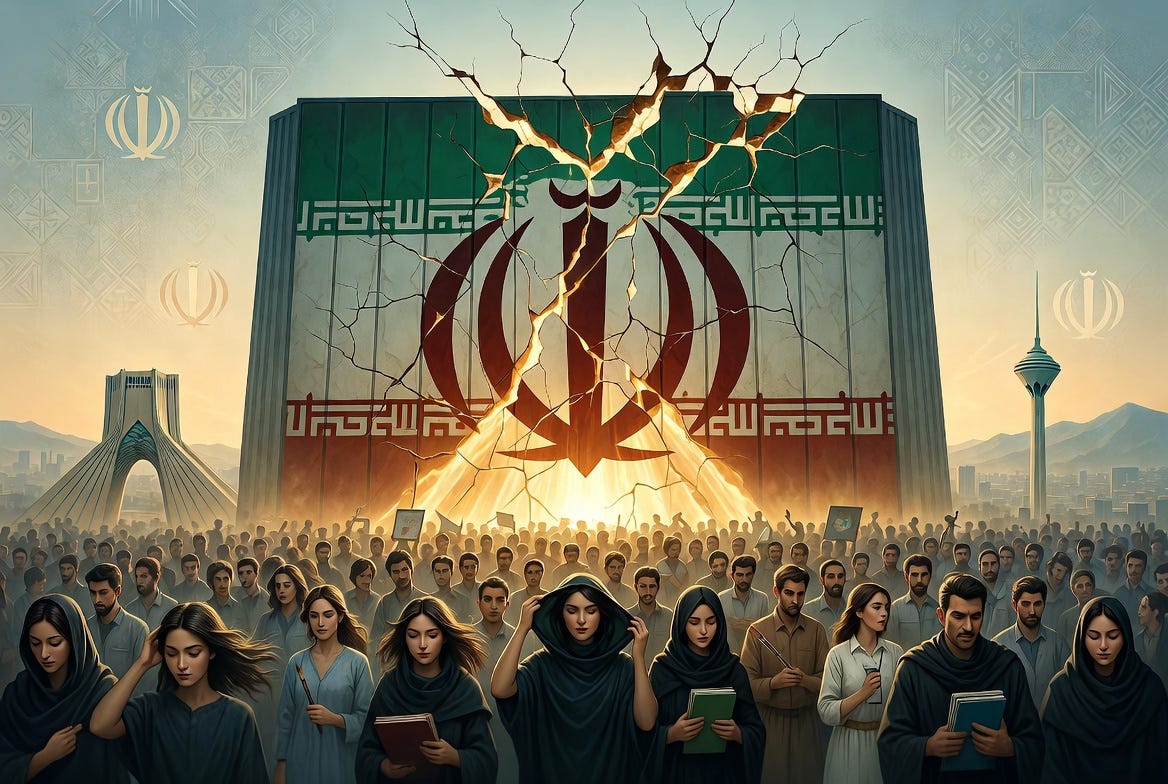
The conflict is framed almost entirely as a contest between Washington and Tehran’s ruling apparatus, as though 90 million Iranians are passive spectators. But the regime’s greatest vulnerability has never been American aircraft carriers. It has always been its own population.
The real long-term threat to the Islamic Republic is not whether it can survive another month of sanctions or launch another missile barrage. It is whether it can indefinitely suppress a society that remains economically strained, culturally defiant, and fundamentally hostile to the Islamist gangsterism imposed on them.
This is precisely why the regime invests so heavily in censorship, surveillance, morality enforcement, internet shutdowns, and psychological intimidation. A truly confident and legitimate government does not fear women singing, students protesting, labor strikes, satire, dancing, or uncovered hair. Khomeinists fear all of these things because they understand that beneath the surface of militarized “resistance” lies a profound crisis of legitimacy.
Ultimately, The Atlantic article mistakes endurance for strength and stalemate for victory.
The Islamic regime may survive confrontation longer than many Western analysts expect. But surviving through coercion, regional arson, black-market adaptation, and permanent repression is not evidence of strategic success. It is evidence of a regime trapped in its own revolutionary pathology.
And the deeper irony is that the very “resilience” the article describes is also what guarantees the regime’s long-term unsustainability. A system built entirely around siege psychology, ideological extremism, corruption, and external confrontation can persist for years — even decades — but it cannot regenerate itself indefinitely.
The article asks whether Trump is losing. The real historical question is how long the Islamic Republic can continue occupying a civilization that never truly accepted it.